

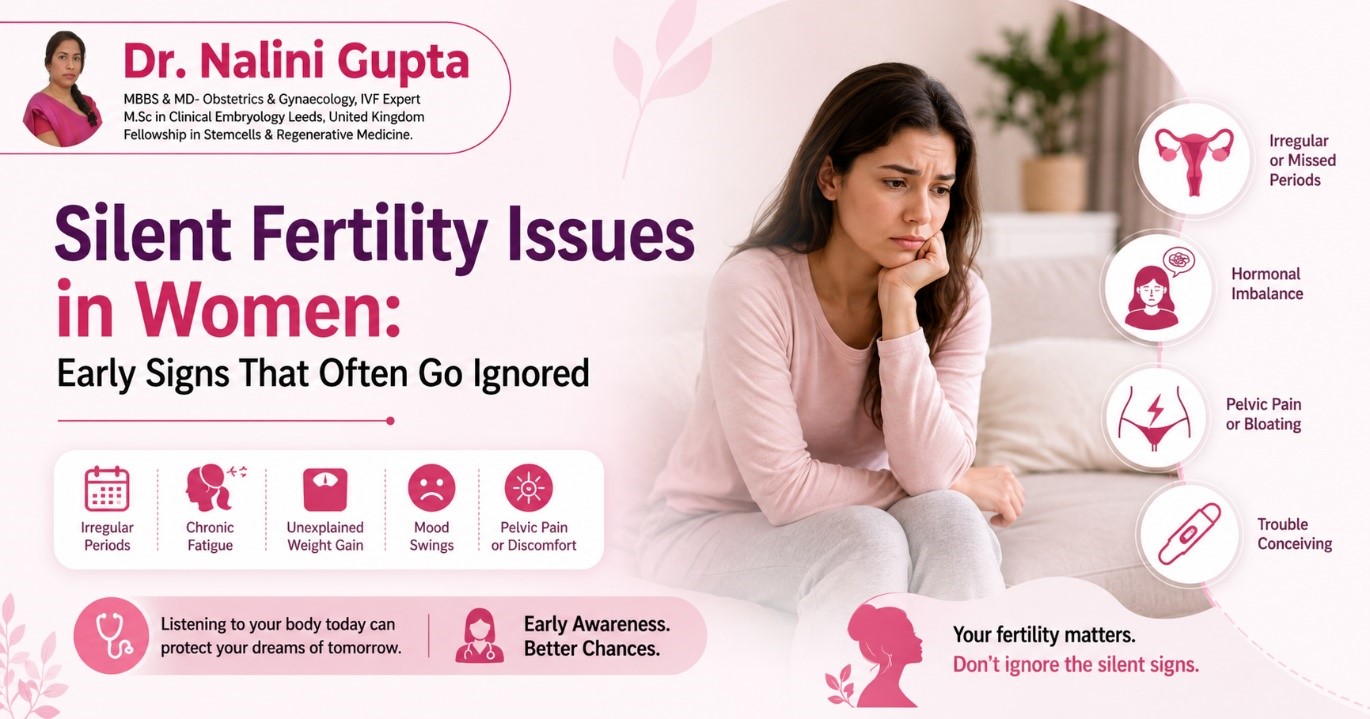
Fertility struggles rarely announce themselves loudly. More often, they show up as small, easy-to-miss changes that women brush off for months, sometimes years, before connecting the dots. A missed period gets blamed on stress. Fatigue gets blamed on work. Painful cramps get treated as “just how periods are”. And by the time someone finally asks a doctor about it, what could have been caught early has quietly progressed.
That’s really the heart of the problem. The early signs of infertility in women that are often ignored aren’t dramatic, and that’s exactly why they slip past unnoticed.
Irregular Or Absent Periods
A cycle that swings wildly in length or disappears for months at a time is one of the clearest signals something hormonal is off. Conditions like PCOS or thyroid imbalance frequently announce themselves this way first, long before anyone thinks to check ovulation or hormone levels.
Painful Or Unusually Heavy Periods
Some discomfort during periods is normal, but pain severe enough to disrupt daily life is not something to simply push through. It can point toward endometriosis or fibroids, both of which are well-known contributors to fertility difficulties when left unaddressed.
Unexplained Weight Changes
Sudden weight gain or weight loss, without any real shift in diet or activity, often ties back to hormonal imbalance. Insulin resistance and thyroid dysfunction in particular tend to affect fertility long before other symptoms become obvious.
Skin And Hair Changes
Persistent acne along the jawline, thinning hair, or unwanted hair growth on the face and body can all be signs of elevated androgen levels. These are frequently associated with PCOS, one of the most common yet under-diagnosed causes of infertility in women today.
Recurrent Miscarriage
Losing a pregnancy once is heartbreaking enough, but losing more than one in a row is a signal that shouldn’t be brushed aside as bad luck. Rather than assuming it’s bad luck, it’s worth getting a proper opinion from a specialist recognised among the Best Gyneacologist in Delhi, since it often points to an underlying issue, whether hormonal, structural or immunological, that deserves proper investigation.
Persistent Fatigue And Low Energy
Constant tiredness that doesn’t improve with rest is easy to write off as a busy lifestyle. But when it’s paired with other symptoms on this list, it’s worth looking at hormonal or thyroid causes rather than assuming it’s simply burnout.
Pelvic Pain Outside Of Periods
Pain that shows up during ovulation, intercourse or at random points in the cycle, not just during menstruation, can indicate conditions like endometriosis or pelvic inflammatory disease, both of which are known to affect conception over time.
Why These Signs Get Missed
Part of the issue is cultural. Many women grow up believing period pain, irregular cycles or hormonal acne are just things to tolerate, not symptoms worth raising with a doctor. Combine that with busy schedules and the tendency to normalise discomfort, and it’s easy to see why the early signs of infertility in women that are often ignored stay ignored for so long.
The good news is that most of these signs are manageable and often reversible when caught early. A simple conversation with a gynaecologist, followed by the right tests, can uncover what’s actually going on long before fertility becomes a bigger concern.
When To See A Doctor
If your cycle has been irregular for more than a few months, if pain is interfering with your daily routine, or if you’ve experienced a pregnancy loss, it’s worth getting checked rather than waiting it out. Early evaluation gives far more options than late evaluation ever will.
Dr. Nalini Gupta Fertility Care, with clinics across South Extension, Mandawali and Narela in Delhi, has built a reputation as one of the Best Infertility Clinic in Delhi for women navigating exactly these kinds of concerns. As one of Delhi’s trusted names in women’s reproductive health, the clinic offers the kind of thorough, judgment-free evaluation that turns vague worry into clear answers.
Frequently Asked Questions
Possible signs include irregular or absent periods, severe menstrual pain, unusually heavy bleeding, persistent pelvic pain, hormonal skin or hair changes and difficulty conceiving. However, these symptoms do not confirm infertility and require medical evaluation.
Not necessarily. However, irregular or absent periods may indicate inconsistent ovulation, PCOS, thyroid problems or another hormonal condition that could make conception more difficult.
Severe pain or unusually heavy bleeding may sometimes be associated with endometriosis, fibroids or adenomyosis. These conditions can affect fertility in some women, so persistent symptoms should be discussed with a gynaecologist.
These symptoms may be related to hormonal imbalance, particularly PCOS or thyroid dysfunction. When they appear alongside irregular periods, a hormonal and fertility evaluation may be helpful.
Recurring pelvic pain during ovulation, intercourse or at other times may be associated with endometriosis, pelvic inflammatory disease or ovarian conditions. These problems can sometimes affect conception.
Repeated pregnancy loss may be linked to genetic, hormonal, uterine or other medical factors. Two or more pregnancy losses should be discussed with a qualified fertility specialist for appropriate evaluation.
Yes. Conditions such as blocked fallopian tubes, reduced ovarian reserve or early-stage endometriosis may cause few or no obvious symptoms. Difficulty conceiving may sometimes be the first noticeable sign.
Women under 35 should generally seek advice after 12 months of trying to conceive, while those aged 35 or older should consider evaluation after six months. Consultation may be needed sooner for irregular periods, severe pelvic pain, previous pelvic infections or repeated pregnancy loss.